
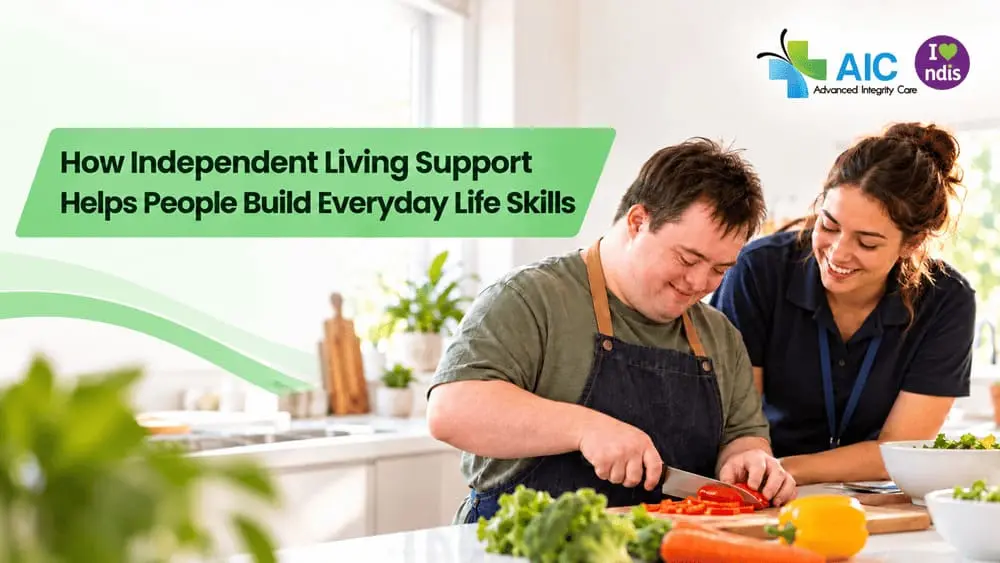
Most people would say that being able to make breakfast, ride the bus, manage your money and create a shopping list are examples of everyday life skills. For people who have a disability, learning how to do each of these things represents a significant move toward increasing independence.
Support for independent living allows individuals to choose what they want to do. Rather than providing assistance for every aspect of their life, proper support will allow individuals to develop new abilities, practice these abilities, and eventually become more confident when taking on additional responsibilities in their day-to-day activities.
In New South Wales, NDIS independent living supports give eligible participants control over how they will live each day, as well as allowing them to pursue their individual goals.
Independent living programs help people with physical or cognitive challenges do many of the same things that other people do each day. They teach individuals the basics of daily living and give people the confidence to participate in their community.
Initially, individuals may need help in preparing their food. Over time and as they become more comfortable with this process, they will eventually be able to prepare their own food with less support.
Every day life skills directly impact how people live every day. These include being able to manage one’s own living space, interact with people, stay healthy physically and engage in activities that are relevant to the local community.
Most importantly, people will progress in different ways. One individual could find success in managing their own shopping list and the other could achieve success in being able to safely follow through with their daily morning routine. Looking for a Respite Care Service in NSW?
Personal hygiene provides a sense of self-respect, dignity, and adds to your overall physical well-being.The goal of Daily Life Assistance is to assist participants with creating a routine of their everyday tasks (e.g., showering, dressing, grooming and organizing).
Visual prompts, having supplies available, and establishing a regular schedule will help you maintain your personal hygiene.
We want to help individuals set their own pace while providing assistance to each individual as needed, depending on his/her choice of level of privacy, and what he/she wants to accomplish.
When you plan to prepare food, there are several different types of skills needed including planning, organizing, being safe with your food preparation and decision-making.
With suitable NDIS daily living support, participants can practise:
A sample would be a participant beginning with making sandwiches and eventually progressing to cooking simpler food.
Support workers can provide education to their clients regarding the significance of employing safe food preparation practices within the kitchen, and they can assist them in making healthier choices about their everyday diets.
A good home needs to be regularly maintained. Managing all your different household chores can become very overwhelming when you do not have an organized schedule for doing so.
Independent Living Skills Training can assist participants in learning how to accomplish common household chores.
This could include doing laundry, washing dishes, making beds, organizing your items and keeping your home clean.
Support workers may want to divide an activity that is too big to be completed in one sitting, into smaller more manageable tasks.
In addition, a person who is learning how to do their own laundry will initially practice sorting out the clothing. Then, after learning to use the washing machine, he/she can be expected to independently perform the whole laundry operation, with assistance when needed.
This gradual approach can strengthen both confidence and practical ability.
Managing money is another valuable aspect of independent living.
Participants will find value in knowing how to identify prices, compare products, keep track of what they spend, and plan for daily grocery shopping.
The following is one way that a support worker can help an individual develop a weekly budget for purchasing food: the support worker can assist the individual in creating a weekly budget of $60 to spend on groceries.
The couple will then have the ability to compare prices at various grocery stores, create a shopping list of all the groceries they need to buy, and calculate the remaining amount of money they will have available once they purchase those groceries.
Financial assistance must always be provided with the consent of the individual who made the decision about whether or not to receive it.
Learning how to manage money can help people who have a disability make better-informed choices about what they spend every day.
The ability to live independently requires a person to be able to state what they want/need, ask questions when something is unclear, and build relationships with other people.
Individuals with disabilities who reside in New South Wales (NSW) can take part in their daily routine in the community they live in through personalized disability support services.
Examples of activities include: ordering food at a restaurant, communicating with store clerks in retail establishments, making arrangements for events, and conveying your desires regarding the completion of tasks around your house.
In addition to being uncomfortable in social situations, there are numerous methods to develop as a result of minor experiences.
Using communication devices and technology that is accessible to all may also improve the way participants interact.
The emphasis will remain on helping each person to express themselves in a manner that best serves their requirements.
Participating in community events can help you maintain your relationships with others, while also helping you enjoy each day.
On the other hand, there are numerous obstacles associated with traveling by yourself. A few examples of these types of issues include learning how to navigate through public transportation systems, being able to follow directions accurately, and dealing with unforeseen circumstances.
Support from the community in being able to plan an outing, select how you are going to get somewhere, and navigate yourself through a location that you know well, can give you experience in doing these things.
Someone could begin to visit a local shopping center with some form of help.
Students can also practice on a known bus route, learn how to utilize travel information and identify safe places for assistance.
Confidence can also be developed and practical experience gained from performing daily tasks. Looking for a Community Access Services in NSW?
The following table shows how structured practice can support everyday goals.
| Life skill | Example support activity | Possible progress |
| Personal hygiene | Following a morning checklist | Completing more routine steps |
| Meal preparation | Practising two simple recipes | Preparing familiar meals with fewer prompts |
| Money management | Planning a $60 grocery budget | Making informed purchasing decisions |
| Household cleaning | Creating a weekly cleaning schedule | Managing regular household tasks |
| Communication | Practising appointment conversations | Expressing preferences confidently |
| Community access | Learning a familiar bus route | Travelling with appropriate support |
These are illustrative activities and possible outcomes, not guaranteed results. The $60 budget is an example, not an NDIS funding amount.
NDIS has different types of support arrangements for each individual with a disability depending upon their disability-related need, goals and approved plan.
Some people will be supported by Core supports; other people may require Capacity Building supports.
At the same time, Supported Independent Living (SIL) is most appropriate for individuals who require a great deal of support from a daily basis, such as those who need a lot of help to live independently and/or be supervised while living independently.
SIL pays for disability related support for individuals with disabilities, it does not pay for their housing.
| NDIS support type | Main purpose |
| Core – Assistance with Daily Life | Help with eligible everyday personal and household tasks |
| Capacity Building – Improved Daily Living | Eligible assessments, therapies and training to develop functional skills |
| Supported Independent Living (SIL) | Ongoing personal support or supervision for people with substantial support needs |
| Individualised Living Options (ILO) | Designing and arranging eligible supports around a person’s preferred living situation |
Importantly, eligibility and funding differ between participants. Therefore, families should check the current NDIS plan before arranging services.
No two people learn in exactly the same way.
Some people like to have visual aids when learning how to do something, some like to see it demonstrated, some need to hear it repeated, and some will do better if they receive a step by step guide.
As such, person-centered disability services need to take into account a person’s goals, preferred means of communication, and current abilities.
For example, a person who likes to cook could want to begin developing their cooking abilities. On the other hand, another individual could place top priority on traveling to a preferred community event.
People can establish their own independence as long as they are pursuing goals that are important to them.
Related Services:
» Disability Services in Newcastle
Participants and families should determine if an independent living support provider in NSW supports the choices of each person, has open communication with its clients and promotes the growth of daily living skills.
Support workers can use their review process to evaluate participant’s progress, modify their routine and have the participant participate in daily decision making.
At Advanced Integrity Care – NSW, the aim is to recognize the benefit of providing individualised support and assist clients in finding realistic options to achieve increased levels of independence.
People’s abilities ought to be assisted by the appropriate type of support, as opposed to having their responsibilities unnecessarily taken away from them.
Related Articles:
» Independent Living: Guide for Participants and Families
» What Does Independent Living Really Mean for NDIS Participants?
» Signs You May Benefit from Independent Living Support
» How Independent living Services empower seniors to live life fully?
» Transitioning to Independent Living with Health Conditions
Self-reliance may be developed in routine daily activities such as; making your own lunch, organizing your bedroom, purchasing items at a store, and/or asking for assistance from others when you are lost and cannot determine where you should go.
Ongoing support for individuals with disabilities allows them to gain the necessary everyday life skills to be self-reliant; allow them to make daily choices regarding their lives; and create a life that is reflective of their personal values.
While learning can be slow at times, every time you learn something new, you have an additional chance to develop as an individual.
For individuals and their family members who are looking into the options for disability support within New South Wales, Advanced Integrity Care – NSW can provide an initial platform to discuss personal goals, what supports may be available, and what type of daily living assistance would best suit each person’s needs.
Advanced Integrity Care acknowledges the Awabakal and Worimi Peoples as the Traditional Custodians of the land on which we work. We pay our respects to Elders past and present and extend that respect to all Aboriginal and Torres Strait Islander peoples.
admin@advancedintegritycare.com.au
Call: (02) 49511530
2/5 Withers St, West Wallsend NSW 2286, Australia
