
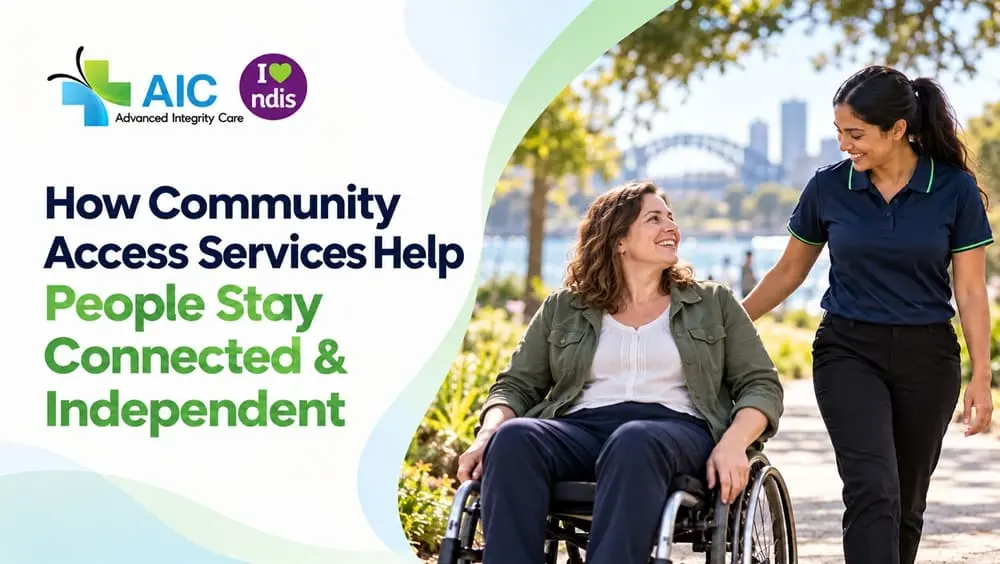
Community is much more than just walking outside. Including opportunities of meeting people, coming back to the places that are already familiar, learning new skills, appointments which can take place in different areas, participation into leisure activities and just being able to make choices between activities of daily living.
Community access support assists people to engage in ordinary community living and remain as independent, informed and in control of their day-to-day activities as possible. Healthy support does not do everything for a person, but encourages them to participate in decisions and activities and routines.
Disability inclusion policy in NSW also stresses access to communities, integration and individual independence. We are about, and committed to addressing barriers impacting on the access of people with disability to transport, services, social activities and community facilities so that they can participate in greater numbers in community life; our response is through NSW Disability Inclusion Plan 2026–2029.
Community access services provide practical support so a person with disability can participate in activities outside of the home.
The precise support varies because all of us have unique interests, capabilities and aspirations. One person may want help to attend a local sporting event, while another may need support with how to navigate independently on public transport.
Community access may include:
Importantly, disability community participation should remain person-centred. Therefore, the participant’s preferences and goals should guide each activity rather than following a standard routine.
Social isolation means not having a chance to socialize or do anything interesting for a long time.
Participating in communities provides you also with spaces for socialization all the time. Attending a corps arts group, a fitness class or a community centre or café once a week will allow someone to acclimate themselves with their neighbours.
The NDIS has also recognised that social and community participation supports can help participants work towards goals involving confidence, social skills and staying connected with their communities.
However, meaningful participation should not mean filling every day with organised activities. Instead, it means helping someone choose activities that genuinely interest them. Looking for a Disability Services in Newcastle?
The opportunity to practice what people learnt in the classroom in real-life scenarios is one of biggest advantages available in NSW.
A support worker might help someone who is grocery shopping by providing greater assistance to start with, for instance. Over time, though, the individual may progress from making their own shopping list and finding items to price comparing and paying on their own.
In the same way that someone who is learning to use public transport at first receives direct assistance. As skill is built, then ideally the support worker would step back from offering support in this area.
This method encourages independence without pressure.
| Community activity | Skills that may develop | Possible benefit |
| Grocery shopping | Budgeting, planning, communication | Greater everyday independence |
| Public transport | Route planning, time management | Improved travel confidence |
| Group activities | Communication and social skills | Stronger community connections |
| Recreational activities | Coordination and confidence | Improved wellbeing |
| Appointments | Organisation and communication | More control over personal routines |
| Volunteering | Workplace and interpersonal skills | Community participation and experience |
Progress may look different for every person. Therefore, support should focus on personal goals rather than comparing one participant with another. Looking for a Disability Services in Chisholm?
Independence does not necessarily mean completing every task without assistance.
Instead, independence often means having greater control over decisions.
For example, a participant might choose:
Where they want to go
Who they want to meet
What activity they want to try
How much assistance they need
When they want support
These everyday decisions matter.
The Disability Inclusion Act framework in NSW recognises the importance of people with disability participating in community life and making decisions that affect their own lives.
Therefore, quality community participation support should encourage informed choice rather than making decisions on behalf of the participant.
Regular community participation can also provide natural opportunities to strengthen communication skills.
As an example, one can practice ordering food in a café, interacting with shop staff or making inquiries for directions or group discussions.
These experiences take place in real environments and in some cases provide more purposeful skill development compared to just practicing at home.
Also, visiting familiar places again may prevent anxiety from surfacing for others because they know what to expect.
A support worker is helpful when the participant needs assistance but can provide enough space to communicate and make choices independently. Looking for a Respite Care Service in NSW?
Social and community participation may also encourage a more active lifestyle.
Activities need not always consist of a form of recognized exercise. For example, moving can be sparked by walking through a shopping centre, visiting a park, attending swimming sessions or joining a gardening group.
However, participating in community work may add a bit of variety to someone’s week.
Moreover, doing some fun activities helps in increasing confidence, motivation and belongingness.
The NSW Disability Inclusion Plan outlines social and cultural participation, access to buildings and spaces and general wellbeing as being key in enabling people with disability to feel safe and live well in communities.
Community access also provides opportunities for capacity building.
Instead of simply completing tasks for someone, a support worker can assist the participant to develop the skills needed to perform more of those tasks themselves.
For example, support could involve learning how to:
As these skills improve, some participants may need less assistance with particular activities.
That gradual development is an important part of person-centred disability support.
Community access should never evolve into an endless cycle of repeating the same activities by everyone involved!
For example if a young adult is interested in experimenting with photography then he or she may enjoy going out to parks, art galleries and photography groups. On the other hand, someone who likes sports might select swimming, bowling or going to local sporting events.
Someone else might just want to be able to walk into the shops alone.
This means community access services in NSW that work will always start with what is important to the person.
The activity itself is only part of the support. The larger goal could involve developing confidence, practising communication, building friendships or becoming more independent.
Related Services:
» Medication Management Services in NSW
» Nursing Services Services in NSW
They should allow people to live safely, but also live independently in their communities.
When someone fails to prepare them too much, however, they may feel overwhelmed. Conversely, excessive help can limit opportunities to acquire new skills.
Thus, support workers have learn to know when they need to help and when they should back off.
And the right scale of support is also likely to change over time.
Example: May need help on the entire community trip. Months later, it may only be transport or planning assistance that they ask for.
This advancement should be acknowledged and encouraged.
Community access can create recognition within their own neighbourhood.
Frequenting a local café, library, recreation centre, community garden or sporting club will allow you to forge relationships easily with staff and other members of the community.
The effect is that the person engages more in general community life, as opposed to being involved only in disability-specific situations.
Accessible communities also benefit everyone. The current disability inclusion framework in NSW encourages public authorities to make mainstream services and community opportunities more accessible.
Related Articles:
» Role of Community Participation in Improving Disability Wellbeing
» Benefits of Community Access Services for NDIS Participants in NSW
» Community Access Support: What’s Included & How It Helps?
» How Community Access in NSW Encourages Independence?
» How Community Participation Support in NSW boosts wellbeing?
The best way to support participation in the community starts with listening to the individual who is being served.
Community access support at Advanced Integrity Care – NSW can be used for participating in activities that align with the interests, personal routines and individual goals of a person.
Support should enhance dignity, options and engagement in their own lives whether help is wanted to participate in social activities, go shopping or taking part in leisure activities or just becoming more actively involved with the community.
At the end of the day, community access services are not just for going places. They are about inclusion, connection, confidence and taking greater control over their daily lives.
Community participation can be a critical route to enhanced relationships, confidence and independence when support is flexible and centred on individuals.
Advanced Integrity Care acknowledges the Awabakal and Worimi Peoples as the Traditional Custodians of the land on which we work. We pay our respects to Elders past and present and extend that respect to all Aboriginal and Torres Strait Islander peoples.
admin@advancedintegritycare.com.au
Call: (02) 49511530
2/5 Withers St, West Wallsend NSW 2286, Australia
