
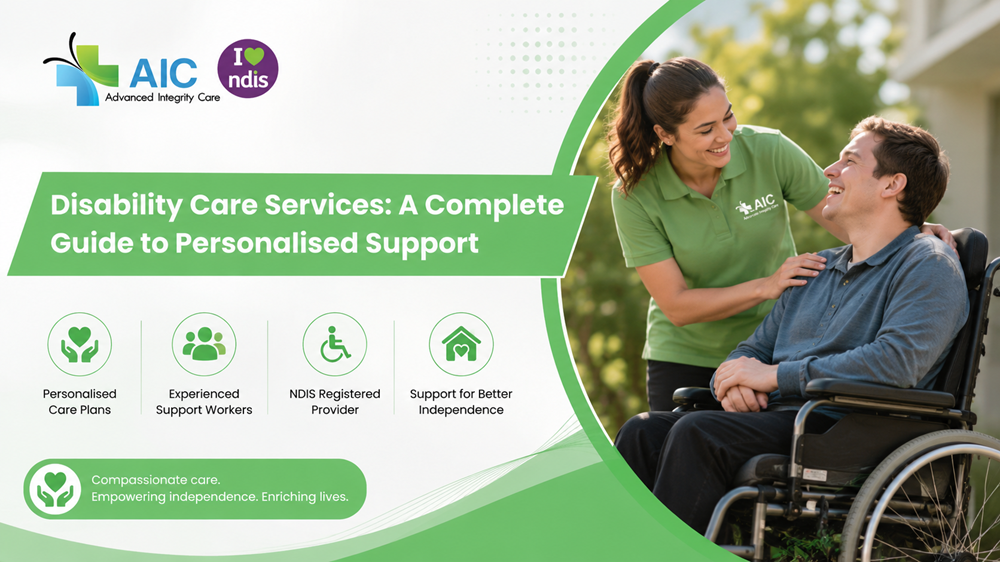
Living with a disability does not mean that every day must be by somebody else’s calendar. Everyone is different, we all have different skills, interests and life situations. Hence, effective disability care specialists should revolve around the person, instead of anyone fitting into a conventional care system.
Personalised disability support can help people and families across NSW lead more manageable everyday lives, whilst also creating opportunities for increased independence, social connection and confidence. Practical support is the help that may be needed with activities of daily living, household tasks or engagement with local community groups.
At Advanced Integrity Care – NSW, we believe disability care should be about dignity and choice and support that responds to a person’s daily life. Get details on NDIS Provider in Newcastle.
Disability care services are providing assistance focused on tasks to support people with disability in their daily life and in achieving more independence.
Support could be assistance at home or personal routines, community access or daily living skills depending on the individual.
NDIS eligible supporters may assist participants in performing activities of daily living, increasing independence and working towards goals listed in their plan.
Most importantly, but let’s be serious — disability support should not mean doing it all for a person. In contrast, good support often prompts the person with dementia to engage in decision making and skill development when they can.
Personalised disability support starts by understanding the individual.
Two people with similar disabilities may need completely different kinds of assistance. For example, one person may want help preparing meals independently, while another may mainly need support accessing appointments, shopping or community activities.
Therefore, personalised care may consider:
As needs change, support arrangements may also need to change. Read on Disability Services in Morisset.
The exact services a person receives will depend on their individual needs, goals and available funding.
| Support area | Examples of assistance | Possible benefit |
| Personal care support | Dressing, grooming and personal hygiene | Greater comfort and independence |
| Daily living assistance | Meal preparation and household routines | Easier day-to-day living |
| Community participation | Social activities, appointments and outings | Improved social connection |
| Household assistance | Cleaning and selected household tasks | A safer, more manageable home |
| Life skills support | Cooking, shopping and routine planning | Increased confidence |
| Transport-related support | Assistance reaching eligible activities | Greater community access |
For many individuals, personal support positively contributes to daily assistance. This may include aid with hygiene, bathing and dressing, grooming and other general personal routines.
According to the NDIS guidance, support workers may provide personal care and activities of daily living based on a participant’s needs and plan.
But respectful support is not just a list of things you check off. A good support worker conveys information, maintains confidentiality and gives the person plenty of time to engage with their own routine.
With the right support, however, those routine duties can feel a bit easier and become less of a struggle.
Daily Living Support can provide support, such as meal preparation, assistance with household tasks, shopping or maintaining everyday life organisation.
Current guidance on the NDIS describes Assistance with Daily Life as a Core support category that provides assistance in undertaking tasks such as cooking, cleaning and personal care, where those activities are part of the participant’s funded supports.
This in turn means that people are able to put more of their energy into the things they care about and want to achieve. Looking for a Disability Services in NSW?
Being part of the community can support confidence, relationships and a sense of belonging.
Yet some people may face barriers when travelling, communicating, accessing unfamiliar places or joining social activities.
That’s where community participation support can help.
For instance, support may involve assistance with attending:
The NDIS includes supports aimed at helping eligible participants engage in social and community activities when these supports are included within their plan.
However, community participation shouldn’t feel like filling a calendar. The activity should actually interest the person.
One of the most valuable outcomes of good disability support is increased independence.
Independence doesn’t necessarily mean doing everything without assistance. Rather, it means having more control over choices and being able to participate in life in a way that suits the individual.
For example, instead of simply preparing someone’s lunch every day, a support worker might help the person learn to select ingredients, follow simple steps and prepare parts of the meal themselves.
Similarly, support can help a person practise:
Consequently, small improvements can gradually create greater confidence.
Some input from a single disabled person in how that disability support functions is of value.
For instance, they might like to have some input into what time support starts, attending the activities with them and how support workers talk to them.
According to NDIS systems and processes that govern support, they nominate who you work with and when as well as their supported arrangements in most plans.
Hence, communication between the participant, family members if appropriate and the support team continues to be vital. Get details on Independent Living Service in NSW.
Whether disability-related support can be funded by the NDIS for an eligible participant depends on their personal circumstances and goals identified in an NDIS plan.
By September 2026, each NDIS plan may contain four varieties of support budget types: Core, Capacity Building, Capital as well as Recurring Supports. Plans are based on individual needs and not every participant is funded in any given budget.
In addition to this, NDIS funded support cannot be used for any support that is not consistent with current NDIS legislation and/or the relevant plan of the person.
Due to individual plans varying, participants must always confirm with their plan or NDIS contact that a service will be fundable and not just advocated for.
Related Services:
» Community Access Service in NSW
» Respite Care Services in NSW
» Disability Services in Newcastle
» Transformative Power of Disability Services.
Choosing a provider involves more than checking what services appear on a website.
Instead, consider how the provider approaches the individual.
Look for a service that values:
Respect: Support workers should respect privacy, decisions and personal boundaries.
Reliability: Consistency matters, particularly when assistance forms part of an everyday routine.
Communication: Participants and families should feel comfortable asking questions or discussing changes.
Flexibility: Needs can change, so support arrangements should not remain unnecessarily rigid.
Person-centred care: The participant’s goals and preferences should remain central.
Independence: Good support should encourage existing abilities rather than automatically taking over tasks.
Regular exposure to known support workers can facilitate communication.
Support workers may become familiar with the routines, preferences and methods of communication of a person over time. As a result, they could identify when there is something in the normal pattern that has changed.
Being consistent may also help to minimize the effort of constantly explaining everyday preferences to new people.
Ever-lasting care however can become too rigid. Participants should be given the opportunity to provide feedback and ask for changes whenever there are changes in their circumstances.
Related Articles:
» Personalised Disability Care in NSW Without the Stress
» Looking for Reliable Disability Support in NSW?
» Role of Community Participation in Improving Disability Wellbeing
» Disability Support Services in Australia: Types, Benefits & Eligibility
» How Disability Support Can Help You Reach Personal Goals
This can take the surprisingly simple form of appropriate disability support.
Sometimes it helps prepare breakfast. This could mean going to an appointment one day, or a community event, and practising a new daily living skill the next.
It does not matter whether this helps the person live with more choice, dignity and confidence with greater independence.
Personalisation in disability care means looking at a person beyond their disability, understanding completely who the individual is, what their daily routines are like and what good looks like for them.
Everyday care can become an avenue toward more independent and connected living if support fits the person rather than the other way around.
Advanced Integrity Care acknowledges the Awabakal and Worimi Peoples as the Traditional Custodians of the land on which we work. We pay our respects to Elders past and present and extend that respect to all Aboriginal and Torres Strait Islander peoples.
admin@advancedintegritycare.com.au
Call: (02) 49511530
2/5 Withers St, West Wallsend NSW 2286, Australia
