
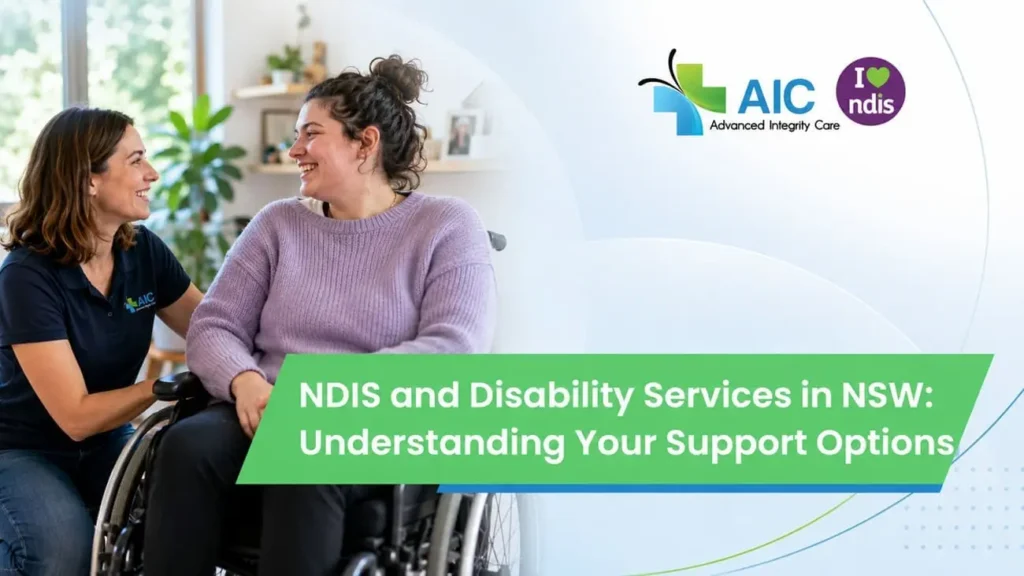
Having a disability may also require different support needs at various points in life. Help with personal care might be the most important thing. It might be skills of daily living, such as getting to college or going out in the community; it might be mobility; it might be health related; or finishing a disability-appropriate exercise and/or fitness program. However, there are a number of options available through the NDIS and disability services in NSW that will enable eligible people to live with more choice, independence and confidence.
Across NSW, participants can access disability-related support using their NDIS funds. All NDIS Plans are Different So knowing what plan you are on, your funding amount and what services you can receive is a key first step.
Whether you are in NSW searching for NDIS disability support services as an individual or a family, understanding the differences between daily assistance, community participation, capacity-building supports and home and living options and disability-related health supports can simplify things hugely.
The NDIS is a federally funded support system for eligible Australians with permanent and significant disability.
NDIS is built to consider different circumstances, disability-related needs and goals rather than providing the same services for every participant. As a result, one person’s plan might look entirely different from the next.
Supports that are funded via the National Disability Insurance Scheme (NDIS) are aimed to help participants with daily tasks, building skills and independence, community participation as well as appropriate access to equipment or home modifications. Eligible applicants on the NDIS now receive Core, Capacity Building, Capital and Recurring support budgets in their plans — however not all participants get funding in every budget. Get details on NDIS Provider in Newcastle.
The right support depends on your individual plan. Nevertheless, several common services may form part of an NDIS participant’s support arrangements.
| Support option | How it may help |
| Assistance with Daily Life | Personal care, meal preparation, cleaning and everyday routines |
| Community Participation | Support to attend social, recreational or community activities |
| Capacity Building | Developing independence, communication and daily living skills |
| Support Coordination | Understanding and implementing an NDIS plan |
| Therapy Supports | Building functional abilities and everyday skills |
| Home and Living Supports | Assistance to live more independently |
| Assistive Technology | Equipment that improves safety, mobility or independence |
| Disability-Related Health Supports | Certain supports connected directly to a participant’s disability |
Importantly, receiving NDIS funding does not automatically mean every service is covered. The support generally needs to meet NDIS funding rules and align with the participant’s plan.
For many participants, NDIS daily living support in NSW is one of the most practical forms of assistance.
Depending on a person’s plan, a support worker may assist with tasks such as:
Current NDIS guidance states that Core supports can include Assistance with Daily Life, Consumables and Assistance with Social and Community Participation. It also notes that Core funding can have a degree of flexibility, provided spending remains within NDIS rules and the participant’s plan.
The purpose should not simply be doing everything for the participant. Instead, where appropriate, support can encourage the person to take an active role and gradually develop more confidence. Looking for a NDIS Provider in Hunter?
Being part of the community can contribute significantly to wellbeing and independence.
Therefore, NDIS community participation services in NSW may assist participants who want to become more involved outside their home.
Depending on individual goals, support workers may help participants:
For example, if somebody wants to join a local art group but feels unsure travelling alone, a support worker may provide assistance while gradually building that person’s confidence.
Consequently, community participation can become more than just an outing. It may also help develop communication skills, independence and a stronger sense of belonging.
Another important area is NDIS capacity building support.
Its Capacity Building funding is designed to help people develop skills and capacities so they do not have to rely on ongoing assistance all the time.
Support coordination, improved living arrangements, increased social participation, employment-related support and daily living skills development also fit into this area based on the participant’s funding approval.
Support coordination for example can assist a participant with understanding their plan, ensuring they are connected to appropriate providers and improving confidence in managing their support. Support coordination is described by the NDIS as a time limited capacity building intervention to help a participant to become more independent in managing their support and funding. Get details on NDIS Provider in Fletcher.
Funding for reasonable and necessary therapy supports may also be available in some NDIS plans.
Typically, therapy should tie in some functional elements related to the participant’s disability and daily living.
Therapy can work on things like communication, personal care activities, mobility, social skills and decision-making and community living skills depending on your needs.
That said, this does not mean that therapy is addressing an illness. In the context of NDIS this might be the development of skills and independence.
Some participants have passive health support needs as a result of their disability.
The NDIS may also provide funding for some disability-related health supports in limited circumstances since these may be needed to assist a person with living their life impacted by their disability.
Current NDIS guidance examples of reasonable and necessary include qualified nursing or therapy, training for support workers and some assistive technologies.
But the line between disability health support funded by NDIS and availability-supported treatment from mainstream health systems can be difficult to identify at times. As a result, participants should always review the details of their specific plan. Looking for a NDIS Provider in Chisholm?
People who want greater independence at home may also explore NDIS home and living supports in NSW.
Current NDIS guidance identifies several possible home and living options, including:
However, these options have different eligibility and funding requirements. Additionally, ordinary costs such as rent and household bills are generally not paid by the NDIS.
For this reason, choosing a home and living arrangement should involve careful planning rather than simply selecting a service.
Reasonable and Necessary Support are the most significant NDIS concepts.
In general, for NDIS to fund support must be related to someone’s disability, contribute to achieving its goals and provide value for money, most likely will work and likely will benefit people.
How the proposed supports interact with family assistance, community services and other relevant government systems is also taken into account under the NDIS.
NDIS funding does not usually cover things such as ordinary living costs, income replacement or care and support that would be funded by other systems.
The question is, not simply “Would this service help me?” The second piece is, “Is this an NDIS support that complies with the funding rules for my individual situation?” Get details on NDIS Provider in Rutherford.
Finding a suitable NDIS service provider in NSW can have a major influence on the participant’s experience.
Before making a decision, consider asking:
Most importantly, participants should feel listened to rather than simply fitted into an existing service schedule.
Related Services:
» Independent Living Service in NSW
» Community Access Service in NSW
Good disability support acknowledges that different people have different routines, abilities, interests and aspirations.
For example, two people might have assistance with activities of daily living but their goals may be worlds apart. It might be that someone wants to learn how to cook their own breakfast and another wants help in getting ready for work.
As a result, person-centred NDIS support is about what matters to you.
Disability support at Advanced Integrity Care – NSW is designed with person-centred principles incorporating ways to promote independence, dignity, participation and everyday life within a framework of approved support.
Related Articles:
» What Does Independent Living Really Mean for NDIS Participants?
» Benefits of Community Access Services for NDIS Participants in NSW
» How the Right NDIS Provider in NSW Can Change Everyday Life?
» How NDIS Support Services in NSW Improve Quality of Life?
» NDIS Wound Care Services in NSW the Process
Looking at support according to your needs and goals makes it easier for you to understand what the NDIS might be able to do to help.
Daily living assistance can provide support for everyday activities. On the other hand, community participation can help support your social connection. Capacity building services might promote independence where it is needed, while disability-related health supports and appropriate home and living arrangements might be beneficial for participants with more complex needs.
The NDIS rules and individual plans can also evolve over time. As such, always confirm your current plan and official NDIS guidance before purchasing any support.
In the end, you only prove that more assistance — or disability support — is not necessary. It is about getting the NDIS support that will be right at the right time, in a way that gives genuine choice and respect to the participant & greater control of everyday life.
Advanced Integrity Care acknowledges the Awabakal and Worimi Peoples as the Traditional Custodians of the land on which we work. We pay our respects to Elders past and present and extend that respect to all Aboriginal and Torres Strait Islander peoples.
admin@advancedintegritycare.com.au
Call: (02) 49511530
2/5 Withers St, West Wallsend NSW 2286, Australia
